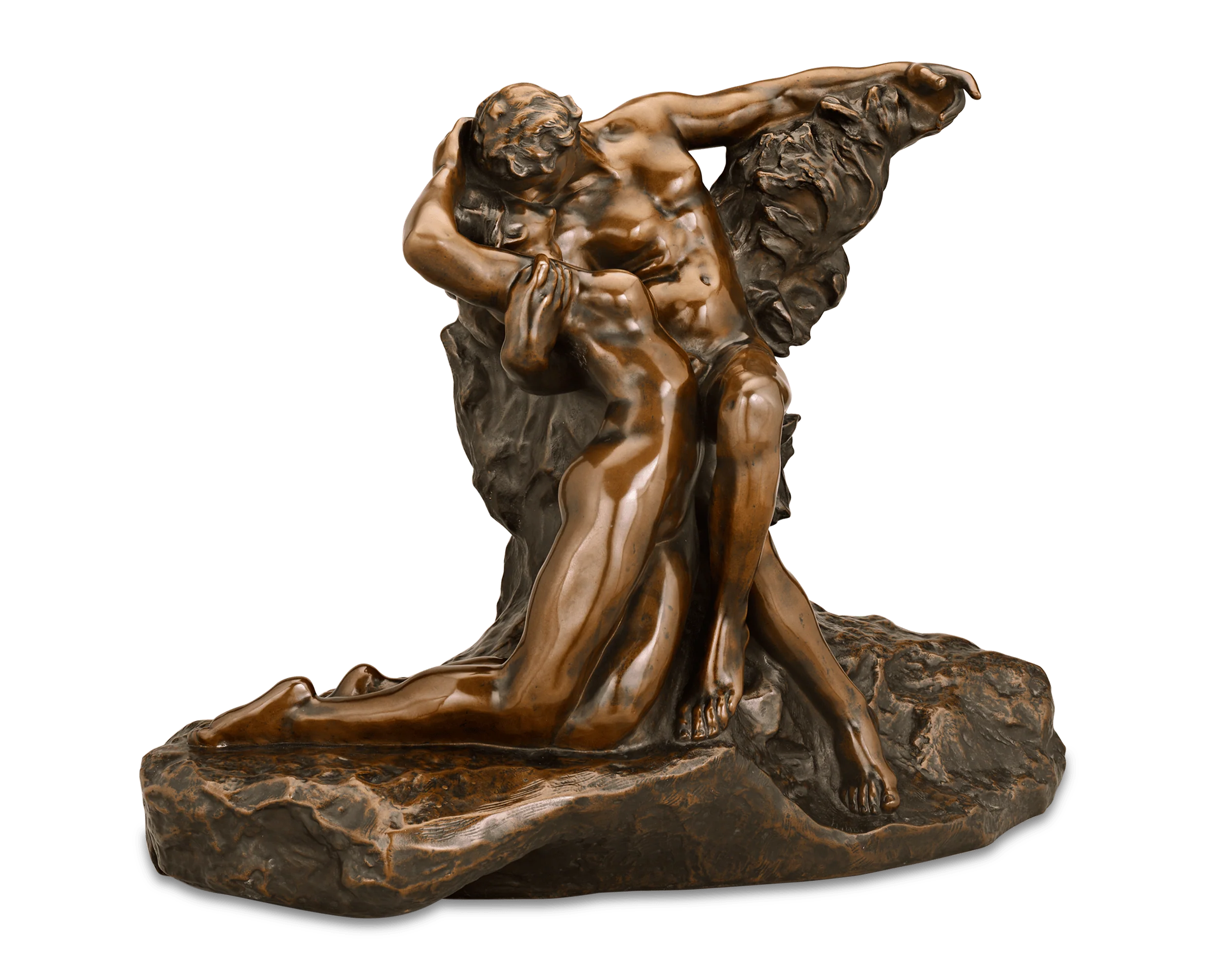
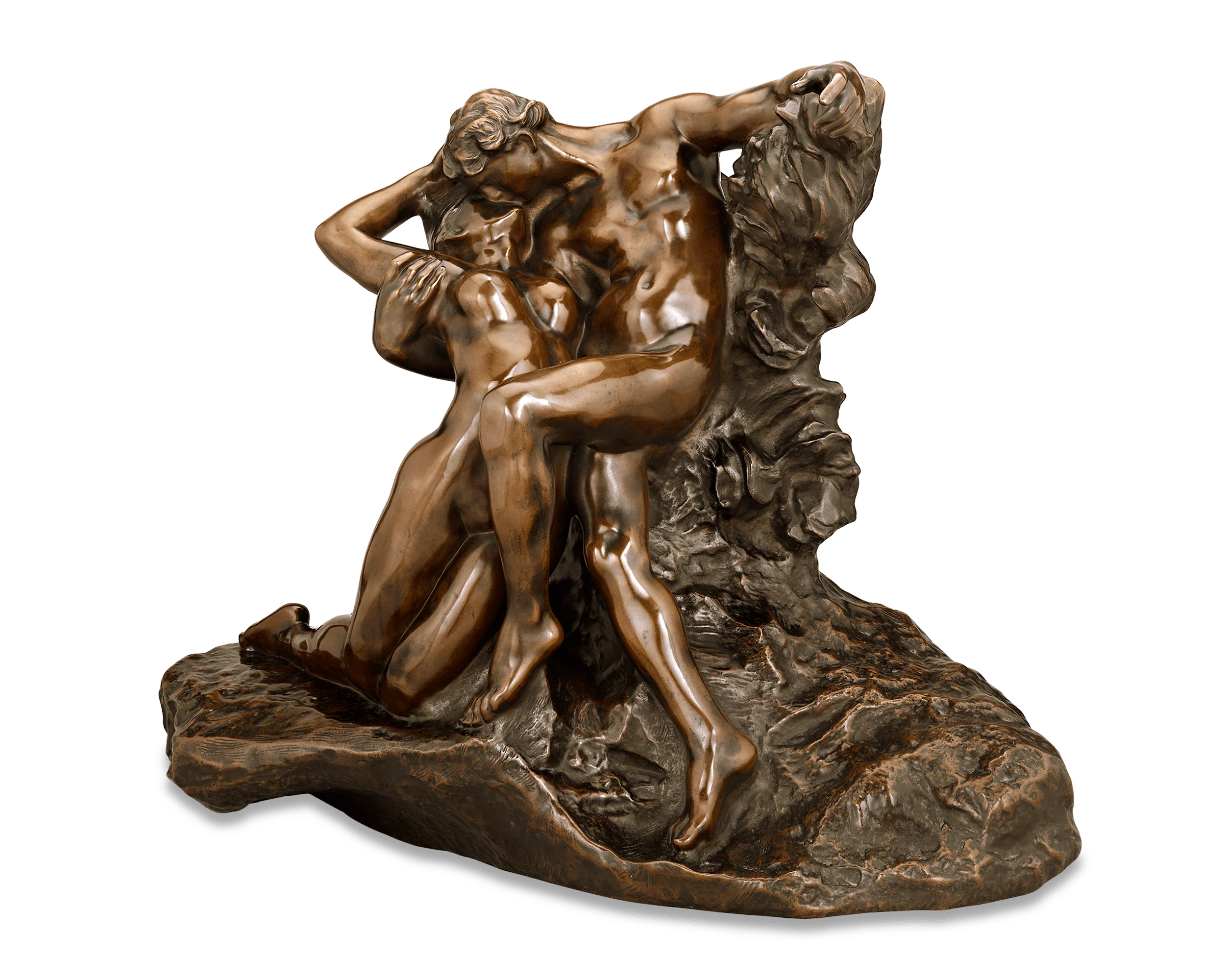

L’Éternel Printemps by Auguste Rodin
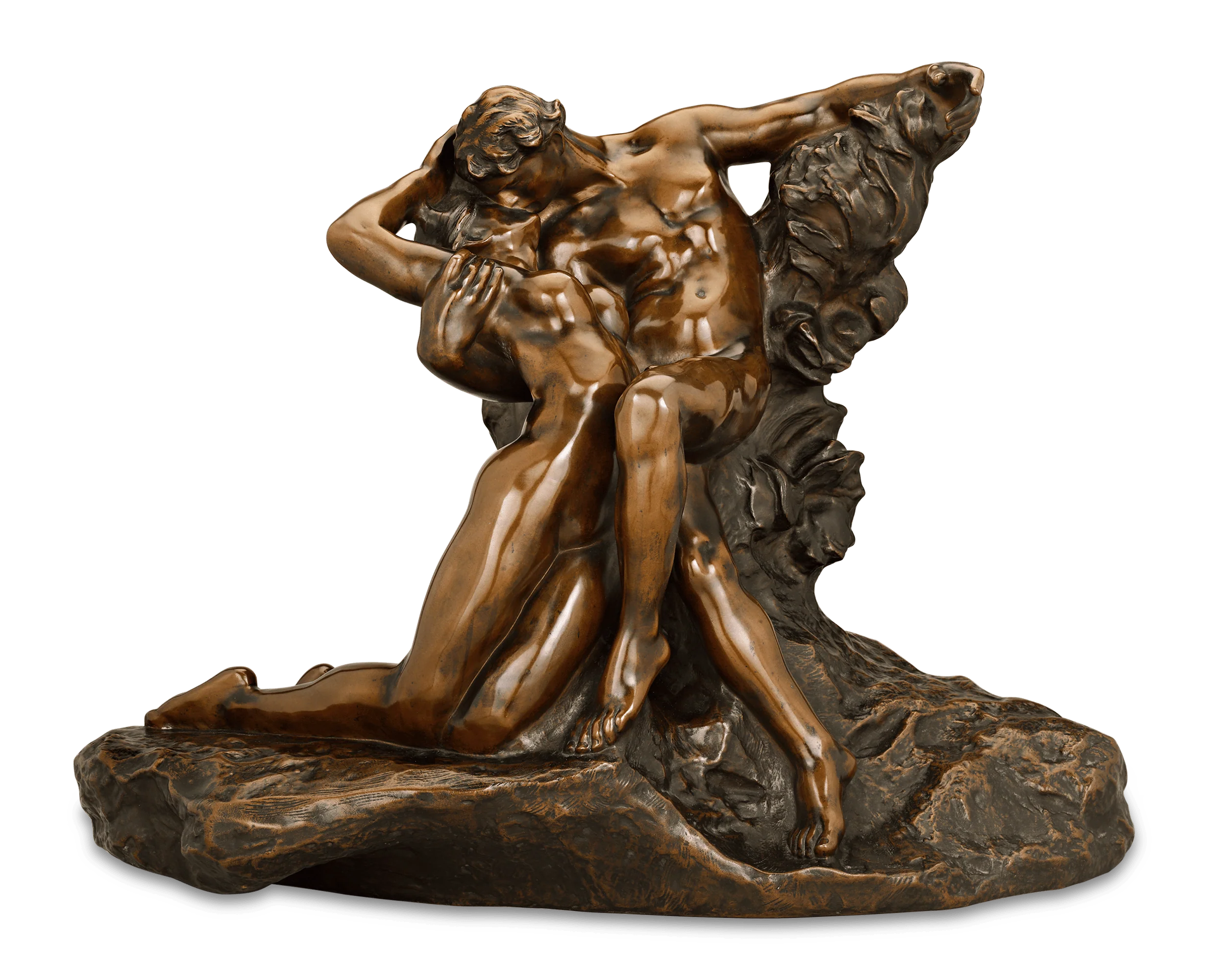
- Two lovers share a passionate embrace in this rare bronze by the great Auguste Rodin
- One of his most iconic works, this scene was originally intended for his famed Gates of Hell
- As a stand-alone sculpture, it became immensely popular after it was shown at the Salon of 1897
- Other versions of this celebrated bronze belong to museum collections including the Met and MFA Boston


Auguste Rodin
1840-1917 | French
L’Éternel Printemps
(The Eternal Spring)
Bronze with brown patina
Signed “Rodin” (on base), with Barbedienne foundry mark
Perhaps one of the most well-known and celebrated sculptures of his oeuvre, Auguste Rodin’s passionate bronze L’Éternel Printemps is the embodiment of this artist’s rare genius. Conceived in 1884, the bronze is regarded as one of the masterpieces of his mature output, conveying a sensuality and aura of passionate love from every angle.
This work was conceived at the height of Rodin’s career in 1884, during an intense period of work on his pivotal Gates of Hell commission. It tells the age-old narrative of forbidden love, depicting the affair of Francesca da Rimini and Paolo Malatesta, who famously appear in Dante’s Inferno for their transgression. Highlighting the lovers’ bliss rather than their ultimate punishment, Rodin felt the bronze was too joyful and removed it from his Gates of Hell. Instead, he executed it as a stand-alone sculpture that would become one of his most acclaimed and beloved works. The Kiss, another masterpiece by the sculptor, shares a similar origin and subject, though L’Éternel Printemps is more dynamic in its pose.
Rodin’s technical mastery was unmatched in his day, and by the turn of the century, he was regarded as the best sculptor since Michelangelo. His composition is dynamic from every angle, utilizing negative space in the arch of the woman’s back and her lover’s outstretched arm to create movement and feeling. Like many of his major works, Rodin looked back to one of his previous models in order to develop his amorous lovers. The female figure is based on his sensuous Torso of Adèle (Musée Rodin, Paris), which appears in the upper left-hand corner of the tympanum of his Gates of Hell. L’Éternel Printemps is also believed to resemble Camille Claudel, a sculptor with whom Rodin began a passionate affair after she joined his studio in 1882. The autobiographical element of Rodin’s own forbidden love perhaps accounts for the work’s intimacy and intensity.
After its successful showing at the Salon of 1897, Rodin awarded the casting of this bronze to the Barbedienne foundry in 1898. This sculpture is from the founder’s second reduction, meaning it is the second largest of four versions they produced. It was also importantly cast during Rodin’s lifetime and thus under his supervision, between 1905-1910. Other versions of this bronze can be found in museums worldwide, including the Musée Rodin (Paris), the Metropolitan Museum of Art (New York), the Museum of Fine Arts (Boston) and others.
Auguste Rodin is counted among the greatest artists of the late 19th and early 20th centuries, along with names such as van Gogh, Monet and Renoir. In the history of sculpture, he occupies a place even more important than his painterly contemporaries, for he alone revived the art of sculpture, returning it to prominence among mainstream art. During the mid-1870s, after two decades of struggling as an artist, Rodin visited Italy and studied the works of Michelangelo, who inspired his first major work, The Bronze Age. Exhibited in Brussels in 1877, it was so well received that the State purchased the work in 1880, which led to the commission of Rodin’s The Gates of Hell. His works, so naturalistic and expressive in detail, were far removed from conventional, decorative sculpture and ultimately transformed the history of art. Today, he is widely regarded as the father of modern sculpture.
This important work is accompanied by a letter from the Comité Auguste Rodin confirming it will be included in the forthcoming Catalogue Critique de l’Oeuvre Sculpté d’Auguste Rodin by Jérôme Le Blay.
Conceived in 1884; cast between 1905-1910
20 1/4″ high x 26″ wide x 13″ deep
Related products
-
La neige au Grand-Lemps by Pierre Bonnard
-
Young Mother Contemplating Two Embracing Children by William-Adolphe Bouguereau
-
Tête de cariatide by Amedeo Modigliani