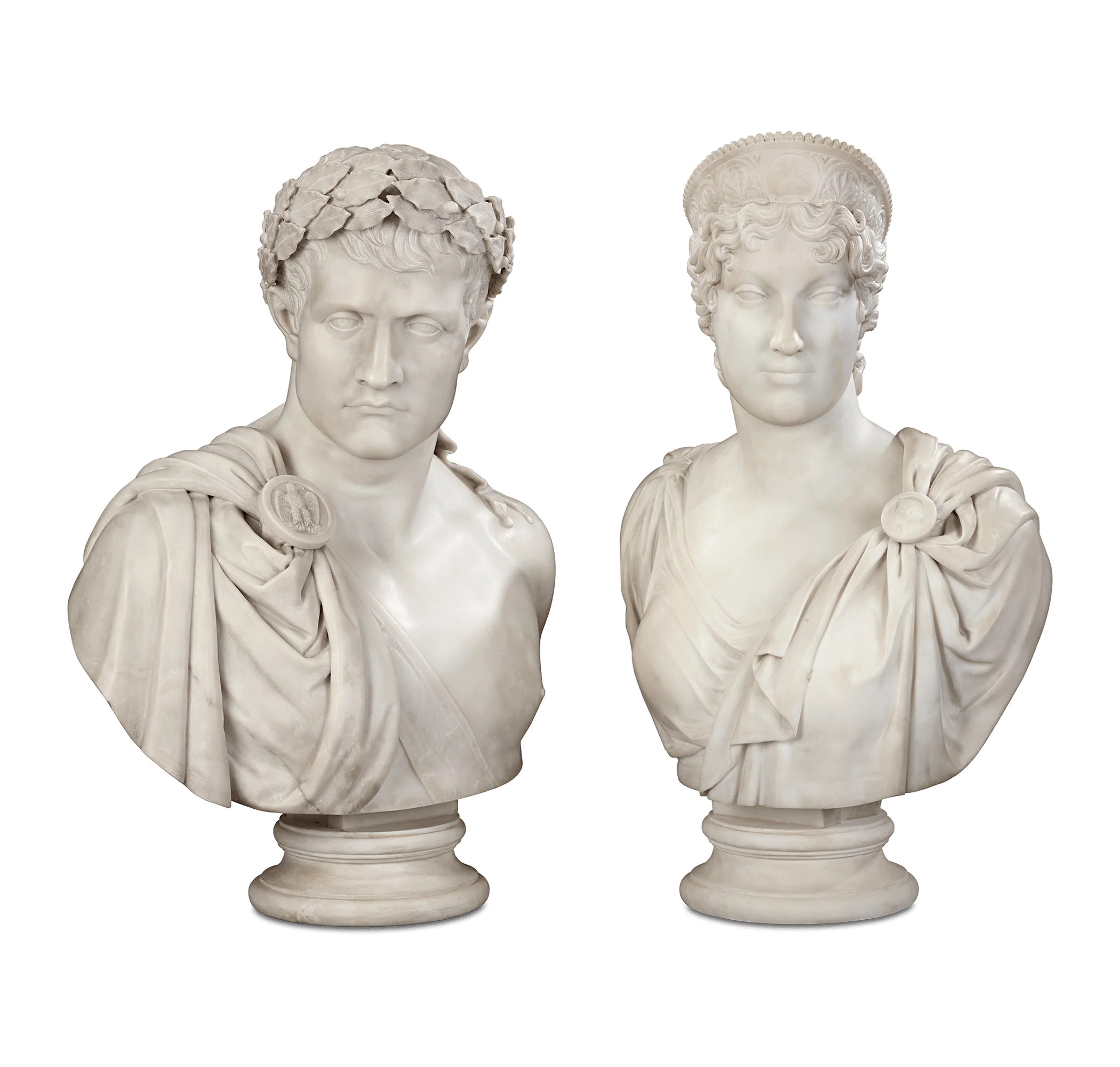

Pair of Carrara Marble Busts of the Emperor Napoleon and Empress Marie Louise
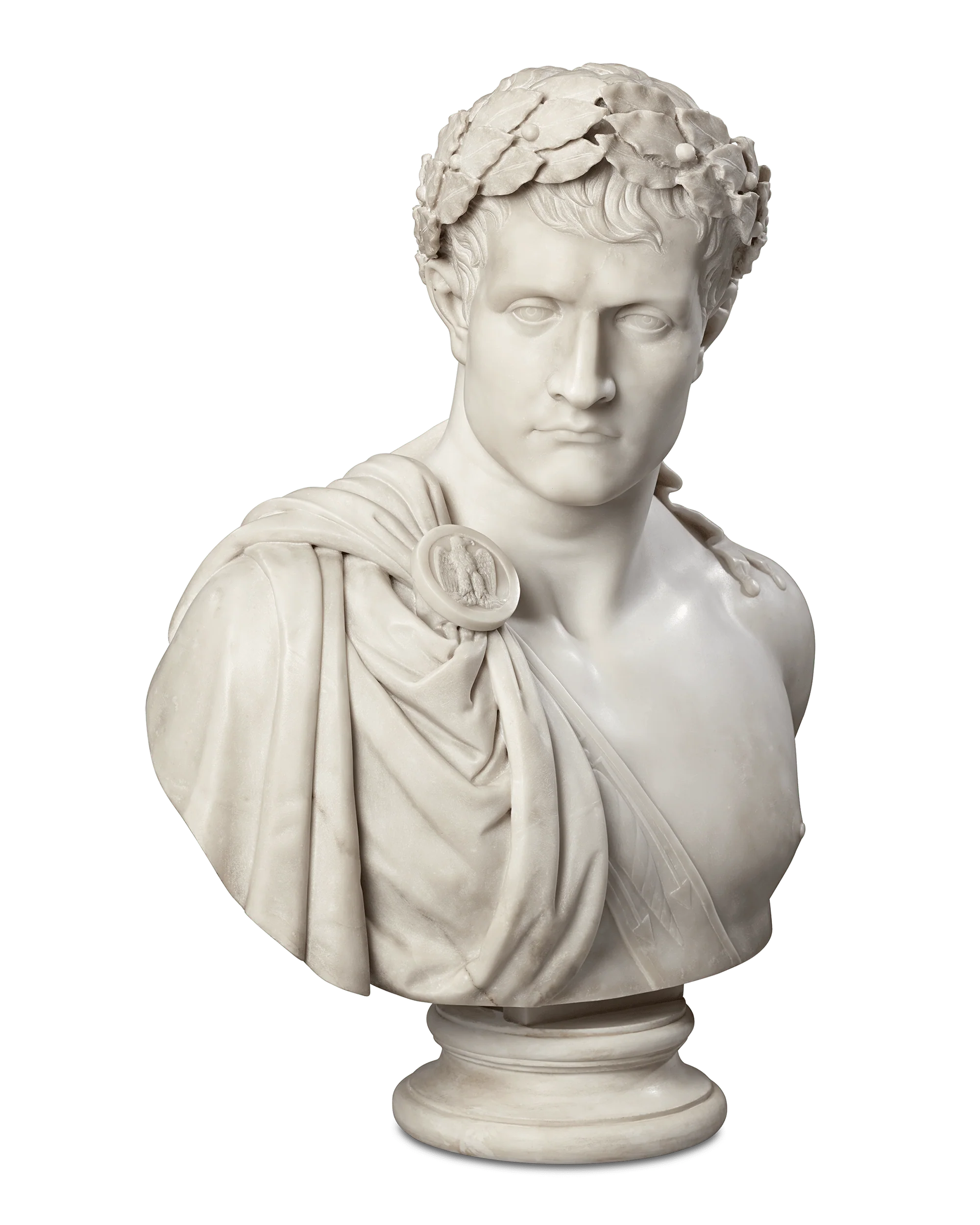
- These extraordinary period Carrara marble busts depict Emperor Napoleon and Empress Marie Louise
- Passed from Napoleon to Napoleon III, these busts were displayed at Château Compiègne
- Created by two famed Napoleonic sculptors, this is the most exquisite pair of busts not in a museum


“I am a true Roman Emperor; I am of the best race of the Caesars—those who are founders.” –Napoleon Bonaparte, 1812
Among the most iconic and celebrated figures in history, Napoleon Bonaparte’s legacy has been immortalized in countless works of art. Yet few pieces carry the personal significance and rarity of this extraordinary pair of Carrara marble busts, almost certainly commissioned by the Emperor himself. These stunning sculptures, depicting Napoleon and his second wife, Empress Marie Louise, stand as some of the most exceptional examples of Napoleonic busts not currently housed in a museum—masterpieces of both historical and artistic importance.
The busts were likely imperial commissions created to adorn key locations during Napoleon’s reign, embodying the grandeur of his empire. After Napoleon fell from power, these sculptures passed from his personal collection to the next most significant ruler of 19th-century France: his nephew, Emperor Napoleon III. During his reign, both busts were prominently displayed at the imperial Château de Compiègne, one of Napoleon III’s most important palaces. Following his abdication in 1870, the Emperor and Empress Eugénie took the busts with them into exile in England. They were among the few treasured possessions they could bring. After Napoleon III’s death, the busts were separated by Empress Eugénie and later reunited in 1936 by the esteemed Parisian art dealer Élie Fabius.
As a visionary leader and cultural influencer, Napoleon was known to commission only the finest artists to craft his likeness in marble. The bust of Empress Marie Louise is signed by the renowned Italian sculptor Gaetano Matteo Monti of Ravenna, likely created around 1810 to commemorate her marriage to the Emperor. Monti’s skill in rendering her delicate features in marble exemplifies his exceptional talent, immortalizing her elegance in stone.
The accompanying bust of Napoleon, attributed to the celebrated sculptor Lorenzo Bartolini, was almost certainly carved earlier, around 1807. Bartolini was one of Napoleon’s favored artists, personally selected by the Emperor to direct the prestigious Carrara sculpture workshop in 1807. The exemplary craftsmanship of this bust, particularly the detailed laurel wreath and the nuanced portrayal of Napoleon’s facial musculature, is consistent with Bartolini’s renowned imperial bust now housed at Versailles. This attribution places Napoleon’s bust as one of the finest not presently housed in a museum collection.
The only other similar pair of marbles is the one attributed to Angelo Pizzi at the Museo Correr in Venice, highlighting the exceptional rarity and quality of our pair. The finesse of the carving and the elegant compositions of these busts surpass their Venetian counterparts, suggesting that the Pizzi busts in Venice may have been modeled after these superior works by Bartolini and Monti. Napoleon revered the legendary leaders of the Roman Empire—especially the military genius of Julius Caesar—and many of his iconic images, including these busts, posed Napoleon and his Empire as heirs to the great dynasty of Caesars.
Standing on beautiful matching bases, these monumental busts possess both an imposing presence and an undeniable beauty. Their storied provenance—having graced the imperial residence of both Napoleon I and Napoleon III—makes them an extraordinary find. To own these very works, once displayed with pride by two of history’s most significant rulers, is a once-in-a-lifetime opportunity. These busts are more than fine marble sculptures. They are tangible links to the grandeur and legacy of the Napoleonic Empire, embodying the iconic reign and strategic genius of one of the most legendary leaders in history, Napoleon Bonaparte.
Bust of Marie Louise signed “GMR” for Gaetano Matteo Monti of Ravenna
Circa 1807 and 1810
Bust of Napoleon: 30 1/16″ high x 24″ wide x 12 1/2″ deep
On base: 74 3/8″ high
Bust of Marie Louise: 30 9/16″ high x 20″ wide x 13 1/8″ deep
On Base: 74″ high
Related products
-
La fille du pêcheur by William Bouguereau
-
A Pompeian Lady by John William Godward
-
The Tax Collectors attributed to Marinus van Reymerswaele